
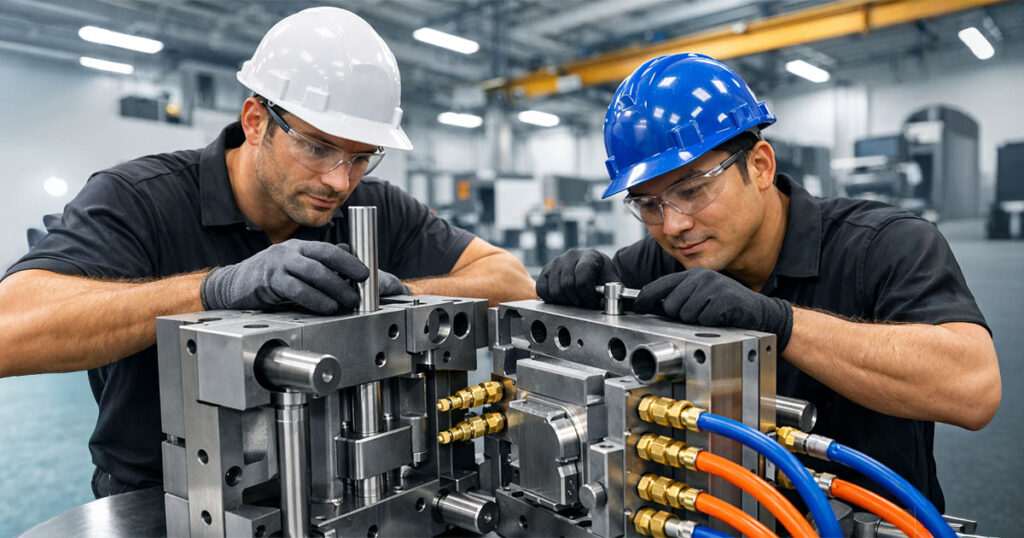
The Metallurgy of High-Tier Tooling: Foundation of Longevity
The first and most critical choice in industrial injection mold manufacturing occurs at the raw material warehouse. Molds operating in heavy-duty environments must resist compressive stress, thermal cycling, and abrasive wear.
Our plant works exclusively with certified tool steel suppliers, implementing rigid selection protocols based on production expectations:
Pre-Hardened Steels (P20 / 1.2311): Excellent choice for large structural components where stability during machining is critical, and mid-volume runs are targeted.
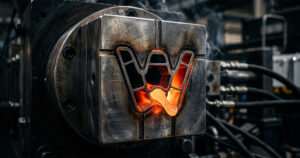
Through-Hardened Steels (H13 / 1.2344): Exceptionally high hot-hardness and toughness. It is our standard material in injection mold manufacturing for technical resins that require high melt temperatures.
Corrosion-Resistant Steels (420 Stainless Steel): Imperative for cleanroom medical parts or applications utilizing PVC resins, which naturally release corrosive hydrochloric gases during plasticization.
Advanced Machine Infrastructure: The Sumiparts Production Floor
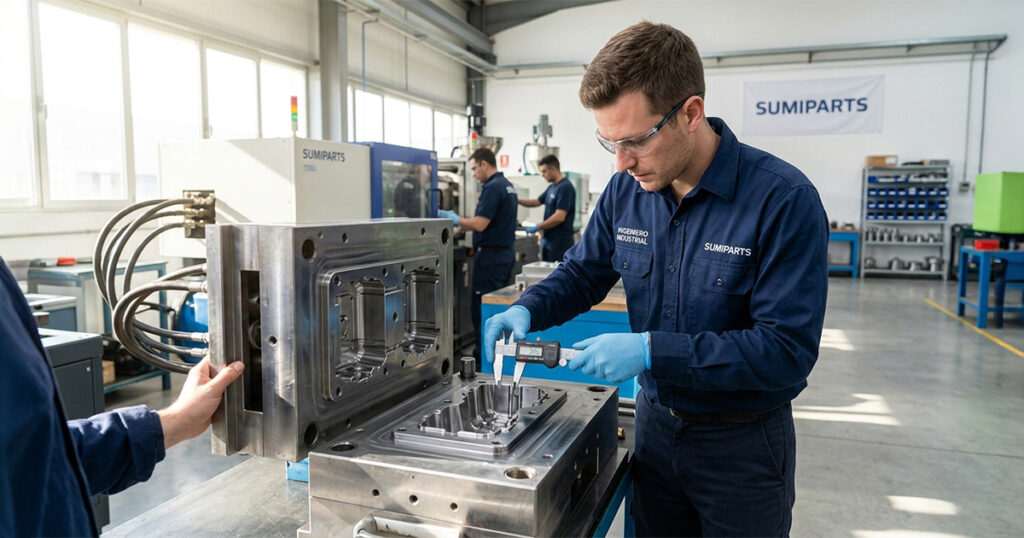
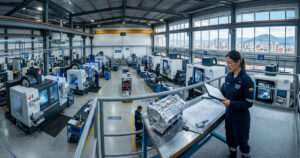
A precision blueprint demands a machine park capable of executing micrometric movements. The Sumiparts plant operates an advanced machining environment specifically configured for high-tolerance injection mold manufacturing:
High-Speed CNC Milling (HSM): Our multi-axis machining centers process pre-hardened and hardened steels at high RPMs. This allows our technicians to cut deep cavities and thin rib profiles with minimal tool pressure, eliminating mechanical stress on the steel block.
Electrical Discharge Machining (EDM): For sharp internal corners, micro-textures, and blind cavities where traditional rotary cutters cannot reach, our CNC sinking and wire EDM cells erode the metal with electrical sparks down to tolerances of $\pm0.005\text{ mm}$.
Precision Surface Grinding: To ensure the parting lines match perfectly and prevent any flash formation, our plant utilizes automated surface grinders to achieve uniform flatness across all plate assemblies.
Mitigating Mold Deflection through Finite Element Analysis (FEA)
During the injection phase, molten polymer enters the tool at pressures that can easily exceed 150 MPa (21,750 psi). Under these extreme conditions, the internal components of the mold experience massive mechanical loads. If the support plates, ejector boxes, or core inserts are under-engineered, the tool will flex microscopically. This deflection leads to erratic wall thicknesses, parting line separation, and rapid tool degradation.
To eliminate this operational risk, our injection mold manufacturing workflow integrates a rigorous Finite Element Analysis (FEA) phase. We simulate the dynamic clamping and injection forces to verify the structural rigidity of every plate assembly. If a high-stress concentration zone is identified, our engineers increase plate thickness, integrate robust taper locks, or add extra support pillars. This upfront simulation ensures that the physical tool built in our plant remains absolutely rigid under peak operational stress.
Turnkey In-House Validation: T1 Sampling and Metrology
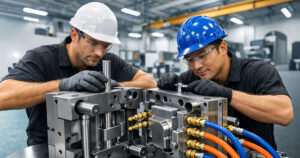
One of the greatest advantages of partnering with a comprehensive manufacturing plant like Sumiparts is our ability to validate the tool under real-world production parameters before final delivery. We do not consider our injection mold manufacturing service complete until the tool passes our T1 sampling and metrology verification.
Once assembly is complete, the mold is transferred directly to our injection molding bay. We run a series of test cycles using the exact production resin specified by the client. The resulting parts are then analyzed in our quality control laboratory using Coordinate Measuring Machines (CMM) and laser scanning systems. This tight feedback loop between the toolmaking floor and the injection molding line allows us to perform micro-adjustments instantly, ensuring the mold is perfectly tuned and ready for immediate deployment on your high-speed production lines.
Heavy-Duty Solutions for Mass Production | Injection Mold Manufacturing
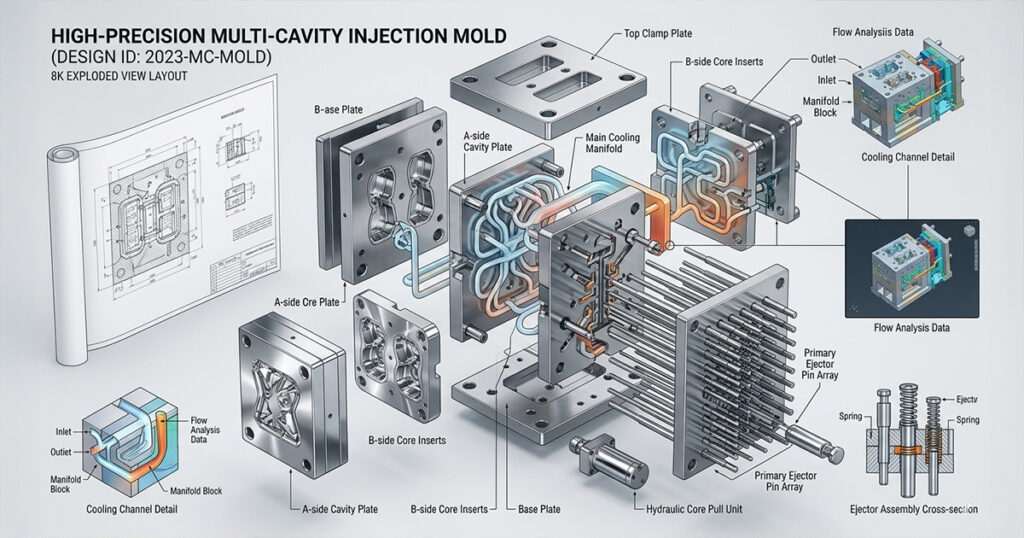
In high-volume manufacturing, sub-standard tooling is a liability your bottom line cannot afford. Choosing the right partner for your injection mold manufacturing needs means investing in a asset that protects your production schedule, lowers your reject rates, and stabilizes your per-part cost. The Sumiparts plant offers the metallurgical expertise, machining technology, and technical transparency needed to deliver world-class industrial tools. Contact our engineering team today to discuss your next high-volume manufacturing program.
Deep Technical Block: Balancing Runner Thermodynamics and Shear Management | Injection Mold Manufacturing
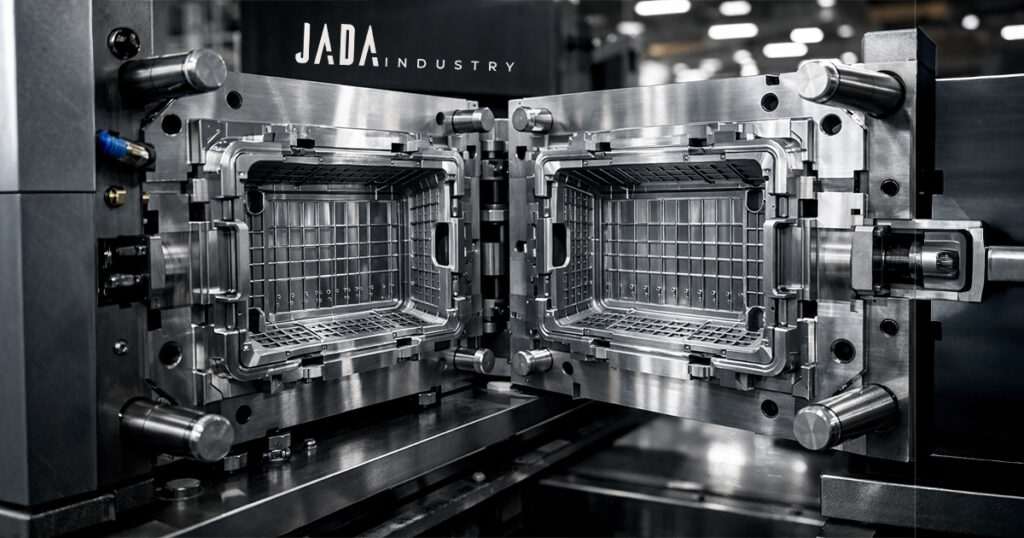
For engineering teams evaluating injection mold manufacturing vendors, the design of the distribution system is paramount. The cold or hot runner network must deliver molten plastic to every cavity at the exact same temperature, pressure, and velocity. In unbalanced runner layouts, the cavities closest to the injection nozzle fill faster and experience higher packing pressures than those at the perimeter, resulting in severe weight and size discrepancies among parts molded in the same shot.
Our injection mold manufacturing division utilizes rheological balancing algorithms to calculate the optimum diameter steps across the entire runner tree. Furthermore, we closely manage shear-induced heating. As plastic flows through tight runner restrictions, friction causes a localized temperature spike.
If the runner system is cut too small, this shear stress can degrade sensitive polymers, snapping molecular chains and weakening the structural integrity of the component. At Sumiparts, our precision CNC milling of runners and gates balances flow resistance with controlled shear rates, delivering homogenous material properties into every cavity and ensuring uniform part behavior across multi-million cycle campaigns.
Pin Alignment, Ejection Synchronization, and Interlocking Systems
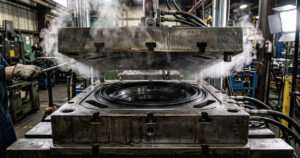
The mechanical movement of a mold during part ejection represents another critical point of wear. An automated mold must open, actuate dozens of ejector pins, retract them, and close seamlessly every 15 to 45 seconds without hitching. Misalignment of guide pins or ejector plates by even a few microns can cause steel-on-steel galling, which completely jams the tool and scores polished surfaces.
During the execution of our injection mold manufacturing services, we incorporate self-lubricating graphite-embedded bronze bushings and precision-ground guide pillars hardened to 60 HRC.
Additionally, for parts with complex side-actions or undercuts, we manufacture mechanical cam slides with hardened wear plates that can be easily replaced during routine maintenance. By engineering robust interlocking mechanisms and utilizing absolute synchronization on the ejector plate assembly, our plant guarantees a smooth, high-speed mechanical cycle that prevents unplanned tool damage and maximizes your facility’s operational uptime.
Learn More...
Want to learn more about our Injection Mold Manufacturing services?
SUMIPARTS is dedicated to serving you. We strive to bring the best solutions directly to you, whenever you need them. Reach out to us via PBX at + 57 601 748 22 13, call us at +57 313 699 13 56, or email us at grupoempresarial@sumiparts.com. Our team is eager to provide the support you deserve.


 English