
I. Overmolding and Multi-Material Injection
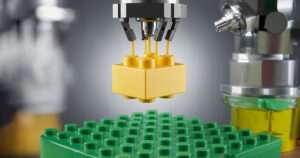
One of the most effective ways to handle complex geometries while adding functionality is through multi-shot or overmolding. This technique allows for the combination of two or more different materials into a single integrated part.
Chemical Bonding vs. Mechanical Interlock: Advanced plastic injection molding involves selecting thermoplastic elastomers (TPE) that chemically bond to rigid substrates like Polycarbonate or Nylon. When the geometry is too complex for a perfect chemical bond, our engineers design microscopic mechanical interlocks to ensure the layers never delaminate.
Functional Integration: This is used to create soft-touch grips, integrated seals, or vibration dampening zones within a single cycle. By eliminating the need for secondary assembly, Sumiparts reduces the “Digital Footprint” of the supply chain and ensures that the final assembly is as robust as a monolithic part.
II. Gas-Assist Injection Molding (GAIM)
For large industrial parts with thick sections or hollow geometries, traditional injection molding often suffers from sink marks and long cycle times. Gas-assist technology solves this by injecting high-pressure nitrogen into the melt stream.
The “Hollow” Advantage: The gas creates internal voids, pushing the plastic against the cavity walls. This ensures a flawless surface finish on parts with varying wall thicknesses—a feat nearly impossible with standard techniques.
Internal Pressure Management: Because the gas acts as an internal “packing” force, it reduces the residual stress within the part. This results in significantly less warping in complex structural housings for the automotive and aerospace sectors.
III. Conformal Cooling: Thermal Precision
In complex geometries, “hot spots” are the primary cause of dimensional drift. Traditional straight-drilled cooling lines cannot reach deep into narrow cores or follow intricate contours.
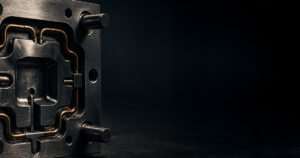
Additive Manufacturing in Tooling: By using 3D-printed steel inserts, Sumiparts implements conformal cooling channels that curve around the part’s geometry.
Uniform Shrinkage: When the entire part cools at the same rate, internal stresses are minimized. This level of thermal control is the only way to hold tight tolerances in high-precision plastic injection molding, ensuring that even the most intricate features remain geometrically true to the CAD model.
IV. Advanced Tooling Kinematics: Slides, Lifters, and Collapsible Cores
Complex geometries often involve “undercuts”—features that prevent the part from being ejected in a simple open-and-close motion.
Mechanical Synchronization: Advanced injection molding tools utilize a complex dance of hydraulic slides and mechanical lifters. These components move out of the way before the part is ejected.
Collapsible Cores: For parts with internal threads or undercuts inside a hollow cylinder, we employ collapsible cores that shrink in diameter to allow for damage-free release. This mechanical sophistication in the mold base is what allows Sumiparts to produce “unmoldable” geometries with high repeatability.
V. Thin-Wall Molding and High-Speed Injection
As electronics become smaller, the demand for thin-wall plastic injection molding (parts with wall thicknesses under 0.8mm) has skyrocketed.
Extreme Injection Speeds: To fill thin sections before the polymer freezes, we utilize high-speed electric injection units with ultra-precise pressure control.
Venting Excellence: When plastic enters a cavity at such high velocities, air must escape instantly. Our advanced venting strategies, often involving porous steels or micro-milled channels, prevent the “diesel effect” (burning) that can plague complex, thin-walled parts.
VI. Variothermal Molding (Heat & Cool Technology)
For parts requiring a “piano black” high-gloss finish or for parts made of highly crystalline polymers, Variothermal molding is the gold standard.
Thermal Cycling: The mold is heated above the polymer’s glass transition temperature ($T_g$) during injection and then rapidly cooled before ejection.
Eliminating Weld Lines: This technique ensures that the polymer flow fronts merge perfectly, making weld lines invisible and increasing the mechanical strength of the part at its weakest points. This is critical for industrial components that must withstand high pressure or aesthetic scrutiny.
VIII. Scientific Molding for Geometric Stability
Consistency across a million-part run of complex geometries is only possible through a data-driven approach.
The Six-Step Study: Every advanced tool at Sumiparts undergoes a rigorous scientific molding study. We determine the viscosity curve, cavity balance, and pressure drop.
Digital Twins of the Process: By recording the exact “signature” of a successful cycle, we can program our machines to detect even the slightest deviation. If the cavity pressure shifts by a fraction of a bar, the machine automatically rejects the part, ensuring that only perfect geometries reach our clients.
IX.The Digital Heritage of Complex Engineering
At Sumiparts, we view advanced plastic injection molding as a vehicle for your company’s ‘Digital Heritage.’ By solving the most difficult geometric challenges today, we create a repository of technical knowledge and digital twins that secure your production for the future. We don’t just provide parts; we provide the mechanical certainty that your most ambitious designs are viable at scale. In a world where the physical and digital are merging, our mastery of injection molding ensures that your high-fidelity components lead the market in both performance and precision.”
XII. Predictive Maintenance and Sensors: The "Smart" Hand-off
The mold maker’s job doesn’t end when the tool is assembled; it ends when the tool is reliable.
In-Mold Sensing: At Sumiparts, our mold makers can integrate cycle counters and pressure sensors directly into the tool. This allows for “Predictive Validation.”
Data-Rich Documentation: Instead of a simple manual, the mold maker provides a digital data package that includes the “signature” of a perfect shot. This allows the factory to replicate the mold maker’s success instantly, bypassing the traditional trial-and-error period that usually follows the delivery of a new tool.
XIII. Final Synthesis: Time as a Competitive Asset
“The true value of a professional mold maker in 2026 is their ability to transform ‘lost time’ into ‘competitive advantage.’ By applying the principles of DFM, advanced metallurgy, and AI-driven machining, the mold making process becomes a lean, high-fidelity engine for innovation. At Sumiparts, we don’t just build tools; we build speed. Every micron of precision we achieve in our workshop is a second saved on your production line and a day gained in your market launch. In the end, the mold maker is the architect of your product’s agility, ensuring that your brand is always the first to arrive at the future.”
Learn More...
Want to learn more about our plastic injection molding services?
SUMIPARTS is dedicated to serving you. We strive to bring the best solutions directly to you, whenever you need them. Reach out to us via PBX at + 57 601 748 22 13, call us at +57 313 699 13 56, or email us at grupoempresarial@sumiparts.com. Our team is eager to provide the support you deserve.


 English